


3D auto-segmentation of biliary structure of living liver donors using magnetic resonance cholangiopancreatography for enhanced
Author
jsrrules
Date
2024-12-13 15:37
Views
413


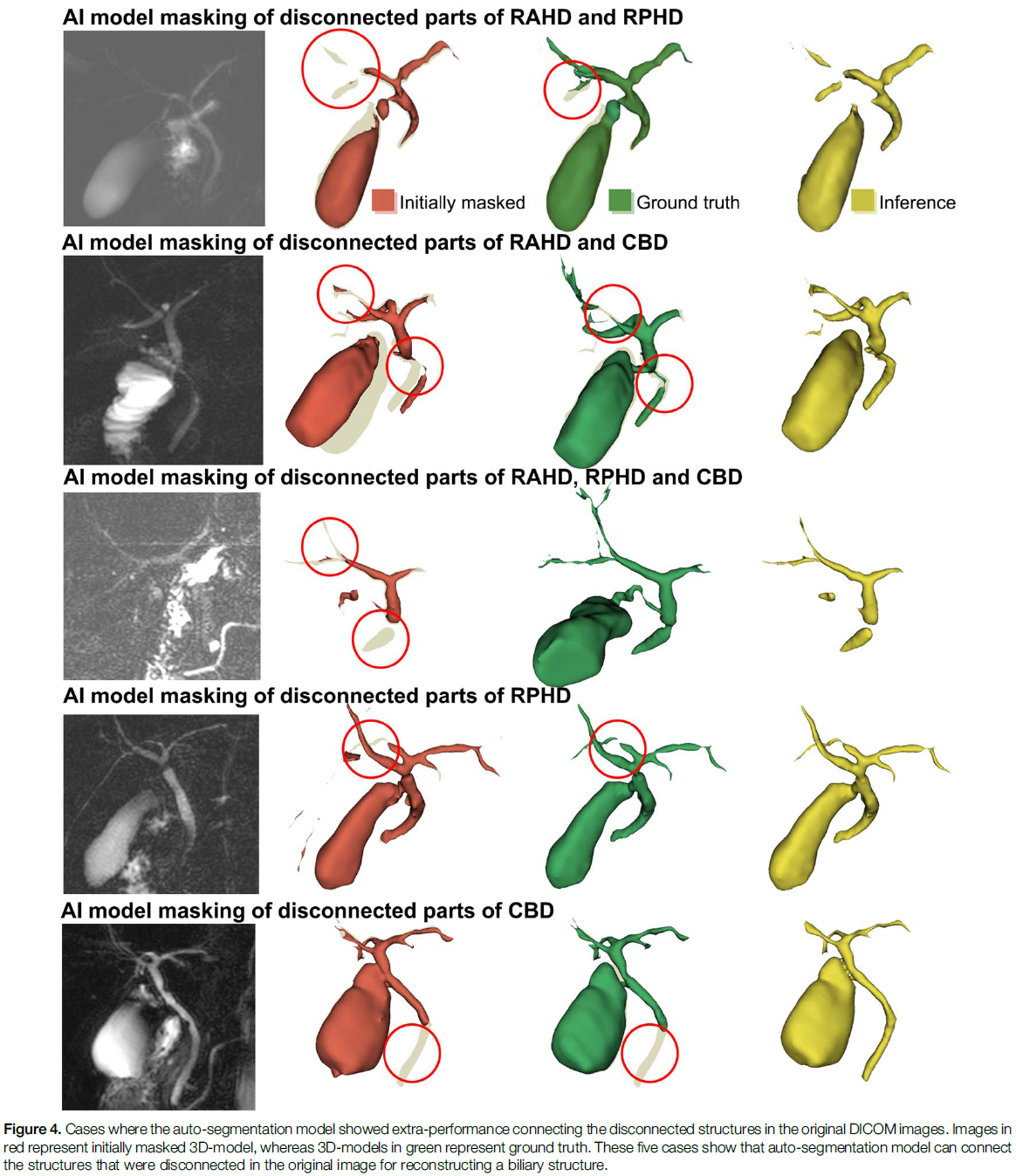
Background: This study aimed to develop an automated segmentation system for biliary structures using a deep learning model, based on data from magnetic resonance cholangiopancreatography (MRCP).
Materials and methods: Living liver donors who underwent MRCP using the gradient and spin echo technique followed by three-dimensional modeling were eligible for this study. A three-dimensional residual U-Net model was implemented for the deep learning process. Data were divided into training and test sets at a 9:1 ratio. Performance was assessed using the dice similarity coefficient to compare the model’s segmentation with the manually labeled ground truth.
Results: The study incorporated 250 cases. There was no difference in the baseline characteristics between the train set (n =225) and test set (n=25). The overall mean Dice Similarity Coefficient was 0.80 ± 0.20 between the ground truth and inference result. The qualitative assessment of the model showed relatively high accuracy especially for the common bile duct (88%), common hepatic duct (92%), hilum (96%), right hepatic duct (100%), and left hepatic duct (96%), while the third-order branch of the right hepatic duct (18.2%) showed low accuracy.
Conclusion: The developed automated segmentation model for biliary structures, utilizing MRCP data and deep learning techniques, demonstrated robust performance and holds potential for further advancements in automation
배경: 본 연구는 자기공명 담췌관조영술(MRCP) 데이터를 기반으로 심층 학습 모델을 활용하여 담도 구조를 자동으로 분할하는 시스템을 개발하는 것을 목표로 하였습니다.
재료 및 방법: Gradient 및 Spin Echo 기법을 사용하여 MRCP를 시행한 후 3D 모델링을 수행한 생체 간 기증자가 본 연구에 포함되었습니다. 심층 학습 과정에서는 3D 잔여 U-Net(Residual U-Net) 모델을 구현하였으며, 데이터를 9:1 비율로 학습 세트와 테스트 세트로 나누어 분석하였습니다. 모델의 분할 성능은 수동으로 라벨링된 기준 데이터(ground truth)와 비교하여 Dice 유사도 계수를 사용해 평가하였습니다.
결과: 연구에는 총 250건의 사례가 포함되었으며, 학습 세트(n=225)와 테스트 세트(n=25) 간에 기초 특성의 차이는 없었습니다. 기준 데이터와 모델 추론 결과 간의 평균 Dice 유사도 계수는 0.80 ± 0.20이었습니다. 모델의 질적 평가는 비교적 높은 정확도를 보였으며, 특히 총담관(88%), 총간관(92%), 간문부(96%), 우간관(100%), 좌간관(96%)에서 높은 정확도를 나타냈습니다. 반면, 우간관 3차 분지(18.2%)에서는 낮은 정확도를 보였습니다.
결론: MRCP 데이터와 심층 학습 기술을 활용하여 개발된 담도 구조 자동 분할 모델은 강력한 성능을 입증하였으며, 자동화 기술의 발전 가능성을 보여주었습니다.
📥 다운로드 횟수: 50회